Kolekcionar vatrogasnog znakovlja
DAMIR MARENIĆ


DVD GRAČANI
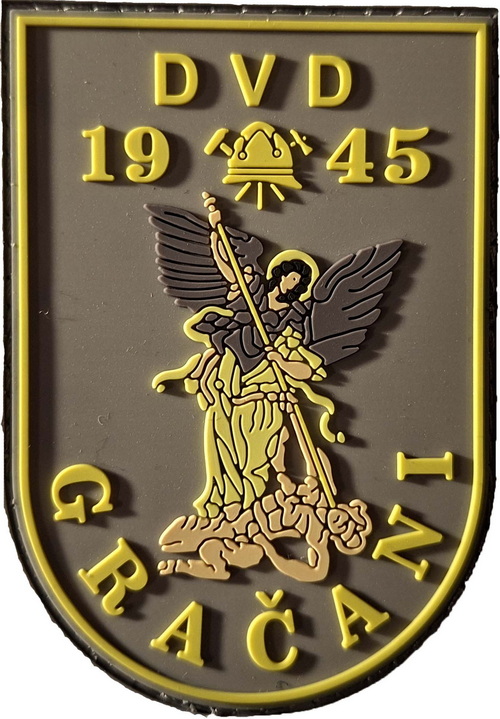

Sadašnji grb Dobrovoljnog vatrogasnog društva Gračani nastao je 2005. godine povodom proslave 60 godišnjice djelovanja. Na grbu društva uz naziv i povjesni vatrogasni znak te godinu osnutka u centralnom dijelu nalazi se lik Svetog Mihaela. Predsjednik društva Denis Ružić u potrazi za pogodnim motivom koji karakterizira Gračane, razgovarao je sa poznavaocem mjesnih običaja i povijesti Zlatkom Puntijarom te je u razgovoru iznjedrena ideja da se u novi grb društva ukonponira lik Sv. Mihaela, čije ime nosi župna crkva u Gračanima. U razgovoru sa župnikom velečasnim Mirkom Kraljem prihvačen je prijedlog te je župnik radi izrade grba, posudio društvu nekoliko fotografija Sv. Mihaela, od kojih se vatrogascima Gračana najviše svidjela fotografija oltarne slike.
Slika nazvana „Sv. Mihael pobjeđuje sotonu“ zauzima središnje mjesto iza glavnog oltara u crkvi sv. Mihalja. U kanonskim vizitacijama prvi se puta spominje 1677. g., a 1699. g. dobila je naziv imago magna (velika slika). Slika je dimenzija 200 x 120 cm te je naslikana tehnikom ulja na platnu i nije potpisana. Autor slike nije poznat, ali se s velikom sigurnošću može reći da potječe iz radionice majstora Hansa Georga Geigera – zagonetnog slikara s kojim je hrvatsko i slovensko slikarstvo 17. stoljeća dosegnulo svoj vrhunac, a o čijoj se biografiji tek devedesetih godina prošlog stoljeća uspjelo saznati nešto više. Značajan je podatak da je u Zagrebu, između ostalih, Geiger opremio crkvu sv. Katarine te crkvu sv. Franje Ksaverskog. Osim manjeg broja potpisanih djela na području sjeverne Hrvatske i Slovenije u kojima je podjednako stvarao, pripisuje mu se i značajan niz nepotpisanih djela te djela naslikanih u njegovoj radionici. Gračanska je oltarna slika upravo jedna od potonjih, a prvi je puta izložena u sklopu opusa Geigerove radionice u Muzeju Mimara na izložbi Sveti trag 1994.g. Ponovno je izložena 2004.g. u Narodnoj galeriji u Ljubljani te 2005.g. u Muzeju za umjetnost i obrt u Zagrebu na zajedničkoj hrvatsko-slovenskoj izložbi Majstor HGG – slikar plastične monumentalnosti.
The current coat of arms of the Gračani Volunteer Fire Department was created in 2005 on the occasion of the 60th anniversary of its activity. In addition to the name of the society, the historical fire service emblem, and the year of establishment, the central part of the coat of arms features the figure of Saint Michael. While searching for a suitable motif that would characterize Gračani, the president of the society, Denis Ružić, consulted Zlatko Puntijar, an expert in local customs and history. During their discussion, the idea emerged to incorporate the figure of Saint Michael into the new coat of arms, as the parish church in Gračani bears his name. In conversation with the parish priest, Reverend Mirko Kralj, the proposal was accepted, and for the purpose of designing the coat of arms, the priest lent the society several photographs of Saint Michael. Among them, the firefighters of Gračani favored the photograph of the altarpiece.
The painting titled “Saint Michael Defeats Satan” occupies a central position behind the main altar in the Church of Saint Michael. It was first mentioned in canonical visitations in 1677, and in 1699 it was referred to as imago magna (great image). The painting measures 200 x 120 cm and was executed in oil on canvas; it is unsigned. Although the author is unknown, it can be stated with great certainty that it originates from the workshop of Master Hans Georg Geiger—an enigmatic painter through whom 17th-century Croatian and Slovenian painting reached its peak, and about whose biography more substantial information only became known in the 1990s. It is worth noting that in Zagreb, among other works, Geiger furnished the Church of Saint Catherine and the Church of Saint Francis Xavier. In addition to a smaller number of signed works in northern Croatia and Slovenia, where he was equally active, a significant number of unsigned works and works produced in his workshop are attributed to him. The Gračani altarpiece is one of the latter; it was first exhibited as part of the opus of Geiger’s workshop at the Mimara Museum in the exhibition Holy Trace in 1994. It was exhibited again in 2004 at the National Gallery in Ljubljana, and in 2005 at the Museum of Arts and Crafts in Zagreb as part of the joint Croatian-Slovenian exhibition Master HGG – Painter of Plastic Monumentality.